Problem
A multilingual vocabulary can be large while using relatively few of its entries on Polish. This study asks how much a Polish-trained byte-level BPE vocabulary changes the token budget, and how the result behaves outside its training domain.
Prior art
The comparison uses GPT-2, cl100k_base and o200k_base as reference tokenizers. It also compares Polish-oriented and GPT-2-style pretokenisation within its own implementation. These are tokenizer experiments; model capability and training efficiency are not measured.
Baseline & falsification threshold
The primary comparison is fertility on the same held-out text. Lossless encoding is a correctness requirement. The source gives no pre-registered statistical or practical threshold for adopting a tokenizer, so numerical compression improvements remain descriptive rather than a model-selection verdict.
Mathematical formulation
round trip: decode(encode(text)) = text
Vocabulary expansion trades shorter sequences for more embedding entries. Its model cost depends on hidden width and whether input/output embeddings are tied; fertility alone cannot determine the best model vocabulary.
Method
The implementation uses a complete byte alphabet, explicit merge tie-breaking and pretoken boundaries. A simple reference BPE core and an incremental trainer are checked for parity. The source reports lossless round trips and twelve passing implementation tests.
Experiment
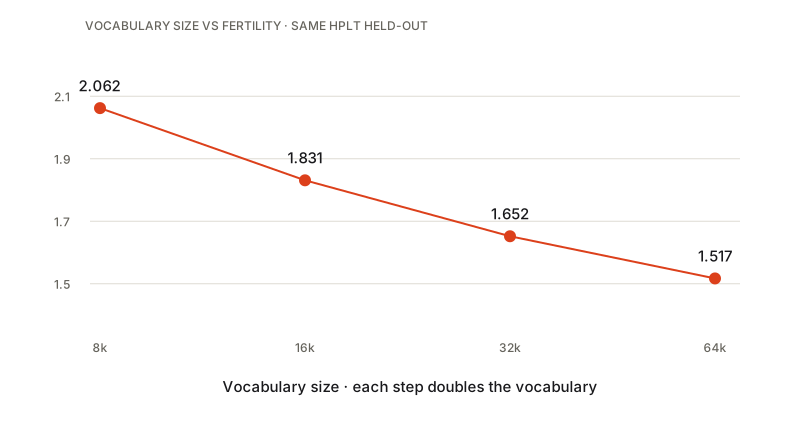
Training uses 314.6 MB from one cleaned Polish HPLT shard. A separate row group supplies the 10.5 MB held-out. The vocabulary sweep covers 8k, 16k, 32k and 64k. Additional evaluations use 3.4 MB of literature and 0.7 MB of Polish Wikipedia.
Research
Vocabulary size has a larger measured effect than the tested regex change. At 32k, Polish-oriented pretokenisation gives fertility 1.652 and GPT-2-style pretokenisation 1.647. The small difference does not support the expected advantage of the Polish regex. There is no repeated-run noise estimate establishing a general equivalence claim.
Verification
All headline reference tokenizers share the same held-out within this study. The Polish 32k tokenizer retains lower fertility than cl100k_base on literature (1.856 versus 2.591) and Wikipedia (1.885 versus 2.988). These are two modest out-of-domain samples; other contributors’ studies use different corpora and must not be merged into this comparison.
Result
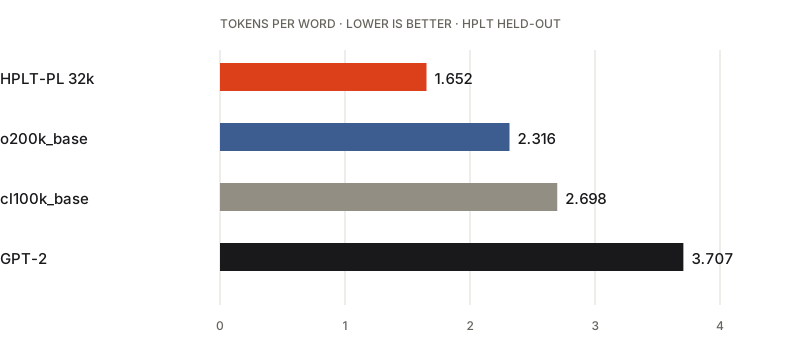
The 32k Polish tokenizer achieves 1.652 tokens per word, versus 2.698 for cl100k_base in the HPLT evaluation. Larger vocabularies lower fertility further with diminishing gains. No downstream model accuracy or general language-understanding improvement is established.
Inspect the original work.
Credit: maciej · tokenizer repository contributor. Editorial web adaptation: Fabryka AI.
Original report and surrounding artifacts ↗
Repository: slayerlabs/tokenizer
Revision: 1b25efca5c1a3891edcfdc47a8945b55e531223c. Repository and source licenses apply; this summary grants no additional rights to the source material.